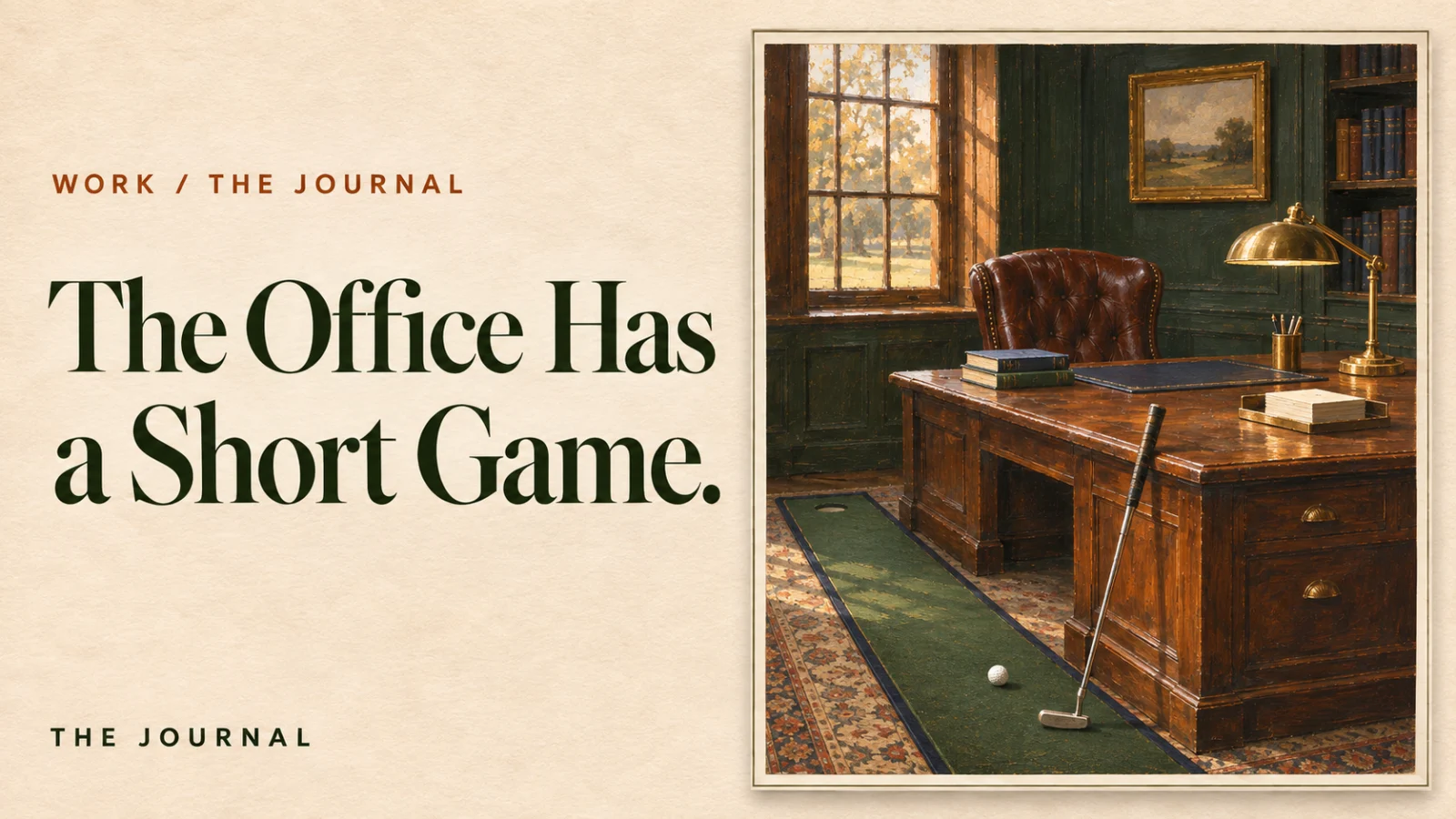
Good technology, better furniture, and a small patch of green carpet that has no business being in the office.
An office can take its owner very seriously. Golf rarely returns the favor.
The screen is full of appointments. The mouse knows every shortcut. A keyboard sits squarely in front of a large monitor, and beneath the desk there is a tangle of cables someone has promised to fix. Everything suggests the next hour will be productive.
Then there is the putter.
Not in a bag by the door, ready for Saturday, but within arm’s reach of the office chair. Beside it, a narrow putting mat. Somewhere among the papers: a scorecard, a pencil shorter than the average meeting agenda, and a ball marker that has never successfully stayed in its allotted tray.
It is an entirely reasonable arrangement. Work is important. So is remembering that it ends.
A workstation with actual work to do
The technology should earn its space. Two quiet, capable 27-inch screens can give calendars, research, design work and spreadsheets room to breathe. A single ultrawide can offer a different kind of calm: one generous view rather than two competing rectangles. The trick is not buying the greatest number of pixels. It is choosing the arrangement that leaves a little desk visible.
A pair of screens may suit one person; a single generous monitor may suit another. There is no point buying a miniature command center when the day calls for a spreadsheet and an email. Nor does every computer need another dock merely because someone has found one with handsome aluminum edges.
Then come the small daily contacts. The compact mechanical keyboard with a proper key feel. A mouse shaped for work rather than a light show. Lighting that makes a late afternoon tolerable without turning the room into a video studio. These are not glamorous subjects, which is precisely why they deserve care. They are touched a thousand times before the putter is touched once.
Furniture with an opinion
A walnut-colored desktop changes the character of all that hardware. Suddenly the screens appear to belong somewhere, instead of having arrived on a corporate expense report. A standing desk gives the room another rhythm. A well-built office chair is allowed to be comfortable without resembling the cockpit of a sports car.
But furniture should not be so precious that the desk becomes a museum. Paper stacks, pencil shavings and the occasional glass ring are signs of use. The good rooms acquire a little evidence that someone has lived in them.
That evidence might include a framed golf landscape. Not a stock photograph of a ball beside a motivational slogan, but a course worth remembering. It gives the eye somewhere to go when the screen has had quite enough of it.
The six-foot interruption
There is an odd beauty in the office putting mat. It has no screen, no login, no subscription and no clever update waiting to install itself. It asks one question: can the ball travel six feet along the line you intended?
The answer is often no.
A narrow putting mat can occupy the space beside the desk rather than an entire spare room. The practice need not be elaborate. It only has to be close enough to interrupt a workday before that day becomes the whole week. A mat that rolls away neatly is more likely to be forgiven by whoever shares the room.
A properly considered eight-foot mat for a midweek putting break. It rolls up when the workday wants its floor back.
In the corner, the putter waits. It is possible to own a perfectly useful office putter and still miss the same three-foot attempt repeatedly. Golf is generous that way.
The small things are the point
Of all the useful things in the room, the golf pencil may have the most character. It is humble, slightly impractical, and almost certainly more memorable than the charging cable beside it. A miniature Titleist bag holding pencils is a small admission of enthusiasm. Graph-paper notebooks can take a sketch of a workflow on Monday and a putting line on Tuesday. A properly framed course flag, one that means something, can make a wall feel like a memory rather than a display.
This is where a room finally becomes personal. Not through an exhaustive buying list, but through the things that have stayed: the print, the souvenir, the old scorecard and the desk accessory someone else might politely question.
For a closer look at the equipment side of the room, there is The Desk Has Other Plans, a considered edit of the useful objects. For the display, One Screen, Not Three keeps the argument simple. The room itself needs no instructions. It only needs to be useful enough for work and interesting enough for everything after it.
The next meeting is in three minutes. There is still time for one putt.
Shop this story.
The useful details, gathered together.
A properly considered eight-foot mat for a midweek putting break. It rolls up when the workday wants its floor back.
Affiliate disclosure: Some retailer links may earn The Links Edit a commission from qualifying purchases. As an Amazon Associate I earn from qualifying purchases.
Part of our guide to home golf simulator rooms and practice setups.
A note worth opening. For Par is our free note on golf, style and the occasional detour, with free art for your walls and your TV. Explore For Par and subscribe free.