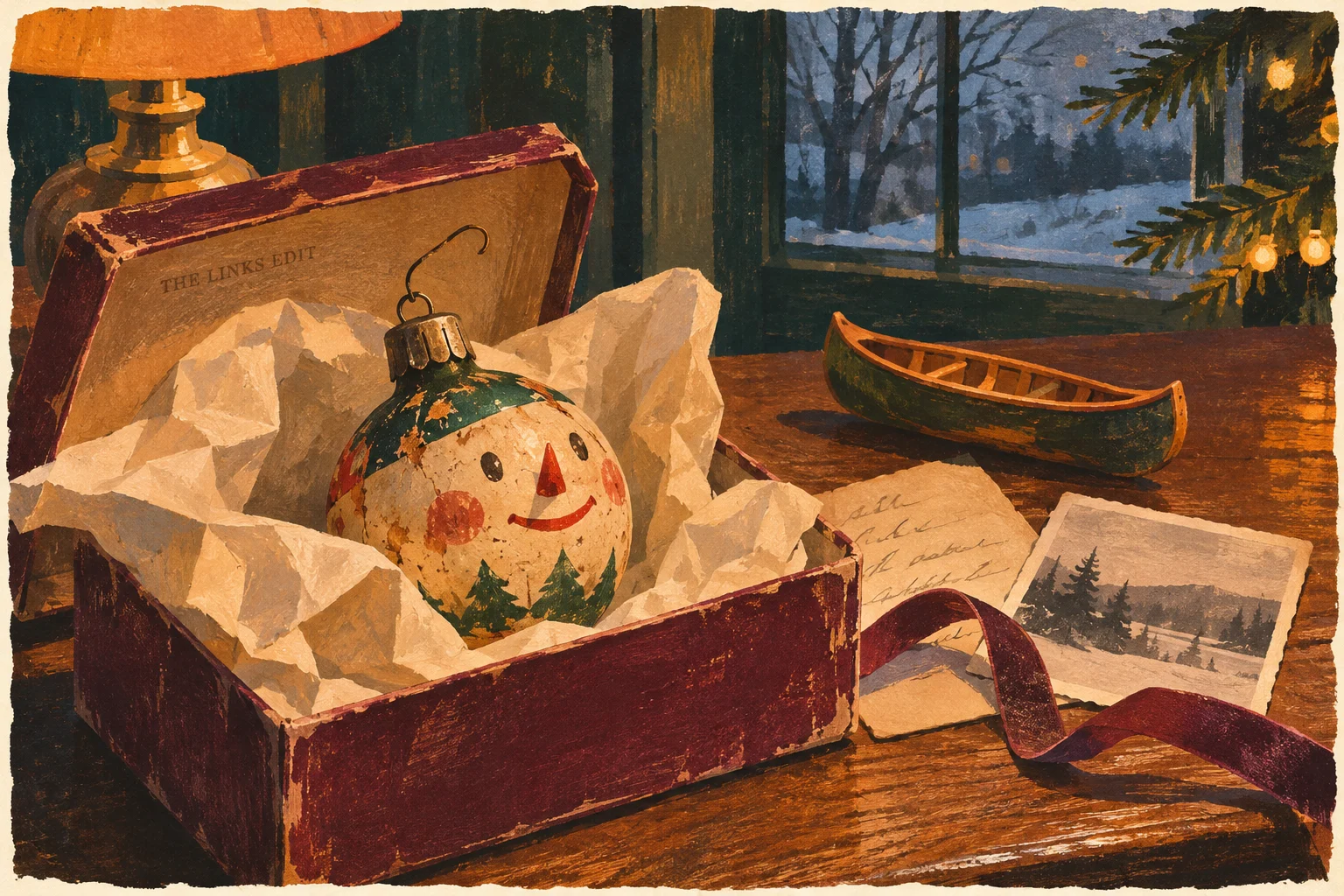
Every December, one ornament receives a special inspection. Of course, it is not the expensive one. Instead, it is the crooked one, the one with a slightly bent hook and a painted face that has been losing its expression for years. And it emerges from tissue paper looking faintly surprised to have survived another eleven months in the box.
Shop this story.
The useful details, gathered together.
Affiliate disclosure: Some retailer links may earn The Links Edit a commission from qualifying purchases. As an Amazon Associate I earn from qualifying purchases.
A hand reaches for a branch near the front of the tree. From across the room, somebody suggests the back, where the damage will be less visible. So this is the first serious disagreement of the decorating season, and it concerns an object that would be difficult to give away.
Of course it goes near the front.
The Decoration With No Resale Value
A family might decorate a tree to match a room. Or it might let the ornaments reflect the people who live there, or at least the people who have spent years dragging boxes up from the basement.
Naturally, the second approach produces less symmetry. For example, a glittery school project hangs beside a delicate glass sphere. Beside it, a wooden animal has lost one ear. Meanwhile, a star’s original color is now a matter of speculation. Still, nothing coordinates except the annual determination to keep all of it.
Meanwhile, the handmade ornament is particularly difficult to judge by ordinary standards. After all, its edges may be uneven because the person who made it was six. Someone who is no longer at the table may have tied the ribbon. And a date written on the back can do more work than an entire box of pristine decorations.
At first, it is tempting to call this nostalgia and move on. But these little objects are also records. Instead, they tell you what people once made with paper, thread, glass, spare time and whatever materials were available. They also reveal which holidays the household cared enough to remember.
A Small History of Keeping
The Smithsonian’s 1978 Trees of Christmas exhibition displayed trees with handmade ornaments ranging from straw and needlework to paper chains, cookies and gilded nuts. The variety is striking. In other words, there was never one correct material or one approved look for a Christmas tree. A century of decorating arguments could have been avoided with that information, though the arguments are arguably part of the fun.
Even so, some ornaments were always fragile, even before they became family treasures. The Henry Ford Museum’s collection includes a German glass ornament from about 1930–1940, an intricate indented form with a silvered finish. In short, it is a small piece of manufacturing history. A crooked paper star, meanwhile, may have been produced at a kitchen table with glue on the chairs. Only one is likely to come with an embarrassing school photograph.
For that reason, a few deserve more consideration once the lights come down. The Balsam Hill Deluxe Rolling Ornament Chest has removable trays and fabric-lined dividers for the collection that has somehow become a family archive. Of course, it cannot make the crooked ornament any straighter. It can make next December’s reunion less hazardous.
Give the Odd Ones a Good Branch
By now, the branch near the front is already overcrowded. A glass bird has an excellent view of the sofa. A school-project angel is leaning into its neighbor. The crooked ornament joins them as if this were the arrangement it had requested all along.
Each year, it emerges looking faintly astonished to have been invited back. Meanwhile, the fashionable ornaments arrange themselves around it. They have the coordinated palette; it has tenure.
Then somebody remembers the tiny wooden canoe. There was a trip, a shop with a bell above the door, a person who insisted the boat would fit in a suitcase. In a Field Notes notebook on the coffee table, the youngest member of the family writes down the name of the lake. The canoe has been promoted from mystery to evidence.
And if the tree ends up looking uneven, so be it. Its job is not to audition for a department-store window. A room can have beautiful objects that earn their place by staying, even after the finish has worn thin.
At last, near the top, the crooked ornament catches a little light. Its bent hook holds. Somebody straightens it, then decides not to. In the end, the best place on the tree belongs to the thing nobody would have chosen from a shelf.
Keep reading: The Wrapping Paper Has Taken Over | Gifts Under $50
A note worth opening. For Par is our free note on golf, style and the occasional detour, with free art for your walls and your TV. Explore For Par and subscribe free.