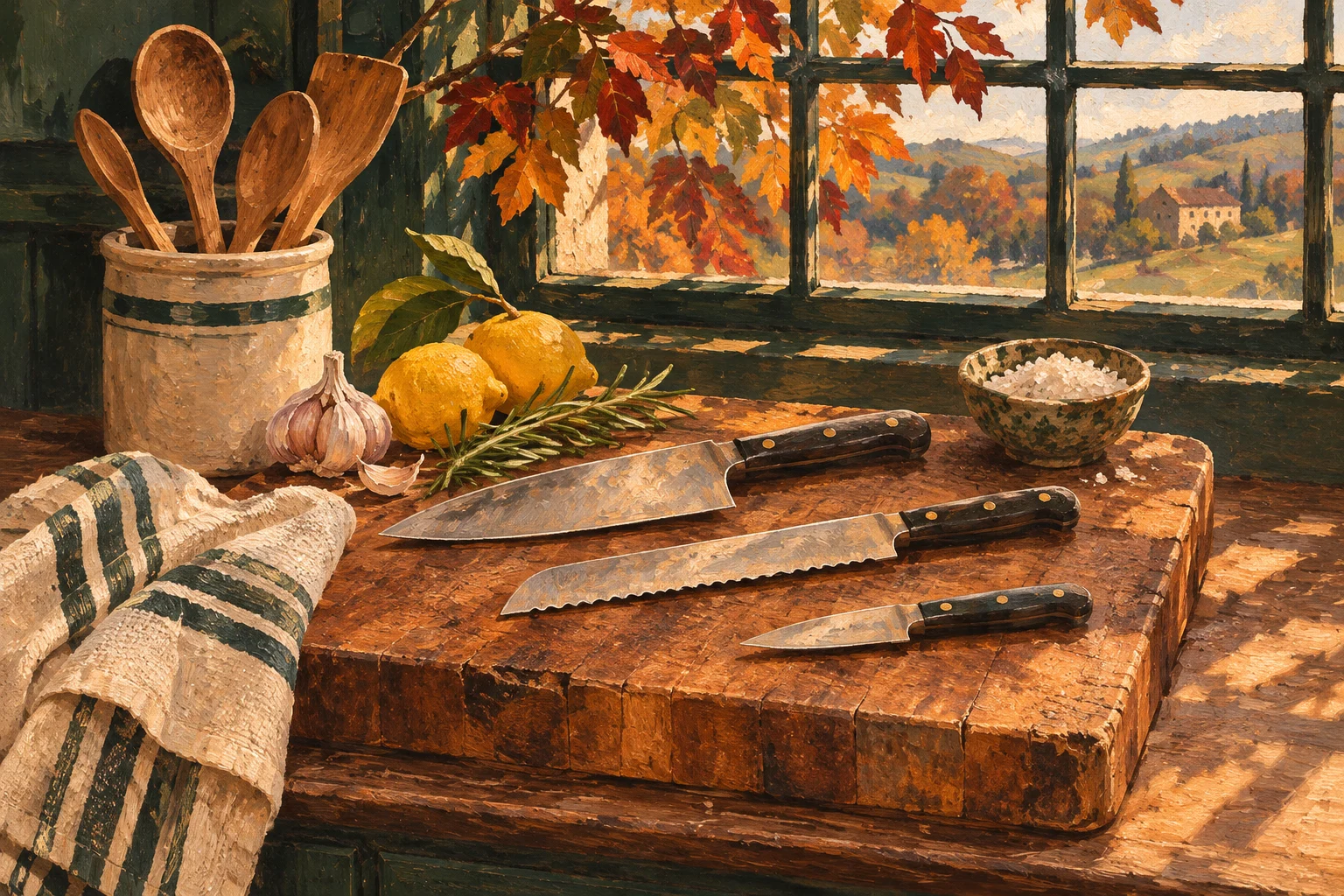
A knife block is an impressive piece of kitchen furniture. For example, twelve slots, matching handles, sometimes a pair of scissors occupying an unusually important position. Still, the question is whether the cook needs twelve knives.
For most dinners, three will do a remarkable amount of work. Of course, this is mildly inconvenient news for the manufacturers of twelve-piece sets, but excellent news for the drawer that never closes properly.
Three Good Reasons
First, a chef’s knife. After all, it deals with onions, herbs, carrots and all the other ingredients that arrive looking nothing like dinner. For example, a comfortable eight-inch blade is a common starting point, though the right length is the one that feels controlled in your hand. Knives should not require an act of courage.
Second, a bread knife. Its job, after all, is to pass through a good crust without flattening the loaf underneath. If dinner involves generous bread, this may be the most popular knife in the kitchen.
Third, a small paring knife. Then apples, strawberries, the questionable corner of a potato. In short, the unglamorous close work that is better done with something precise.
Beyond those three, everything should have a reason. The same goes for the pans that earn cupboard space. Perhaps you carve large roasts. Or you fillet fish. Maybe you simply like a particular Japanese blade. That’s fine. An empty slot in a wooden block, however, is not a reason to develop a new hobby.
Better in the Hand Than on the Shelf
Of course, knives have a mythology around them: German craftsmanship, Japanese precision, legendary steel, supposedly perfect angles. Still, there is history worth exploring in all of it, but none of it tells you whether a handle will feel right after half an hour of chopping.
The Victorinox Swiss Classic 8-inch chef’s knife makes a persuasive case for starting with one capable blade. And it is Swiss-made, light in the hand and meant for the everyday business of chopping rather than a grand countertop ceremony.
A capable Swiss-made workhorse without the twelve-piece ceremony.
For a crusty loaf, the Mercer Millennia 10-inch bread knife brings a proper wavy edge and a comfortable grip. For that reason, a good bread knife makes Sunday lunch easier without requesting shelf space for seven of its cousins.
The useful serrated one for a good crust and the bread underneath.
The Victorinox Swiss Classic 3-inch paring knife handles the work a big blade would only make awkward. Its cost is modest. Yet its place in a kitchen rarely is.
Small, inexpensive and remarkably often the right tool.
Still, a knife can be spectacular in its box and oddly demanding once it joins the normal business of a Tuesday. Instead, the more reliable test is not how many blades are included, but which one gets reached for without a second thought.
Sharp Enough to Be Ordinary
After all, a well-kept knife is a quiet pleasure. For example, a tomato gives way neatly. Meanwhile, herbs stop turning into bruised little piles. Then dinner moves along. Someone steals a slice of tomato before it reaches the platter. Of course, the cook objects on principle and immediately eats the next one.
Ultimately, beautiful knives deserve to be used. In time, the ones worth keeping will eventually lose their sense of occasion. After all, they’ll come out for a sandwich, a Sunday roast and the pear someone wants cut in half.
So there is no need to fill every slot in the block.
Leave room for the good ones.
Keep reading: No Reservations Needed | What Good Pans Sound Like | The Dutch Oven Earns Its Keep
Shop this story.
The useful details, gathered together.
Affiliate disclosure: Some retailer links may earn The Links Edit a commission from qualifying purchases. As an Amazon Associate I earn from qualifying purchases.
A note worth opening. For Par is our free note on golf, style and the occasional detour, with free art for your walls and your TV. Explore For Par and subscribe free.