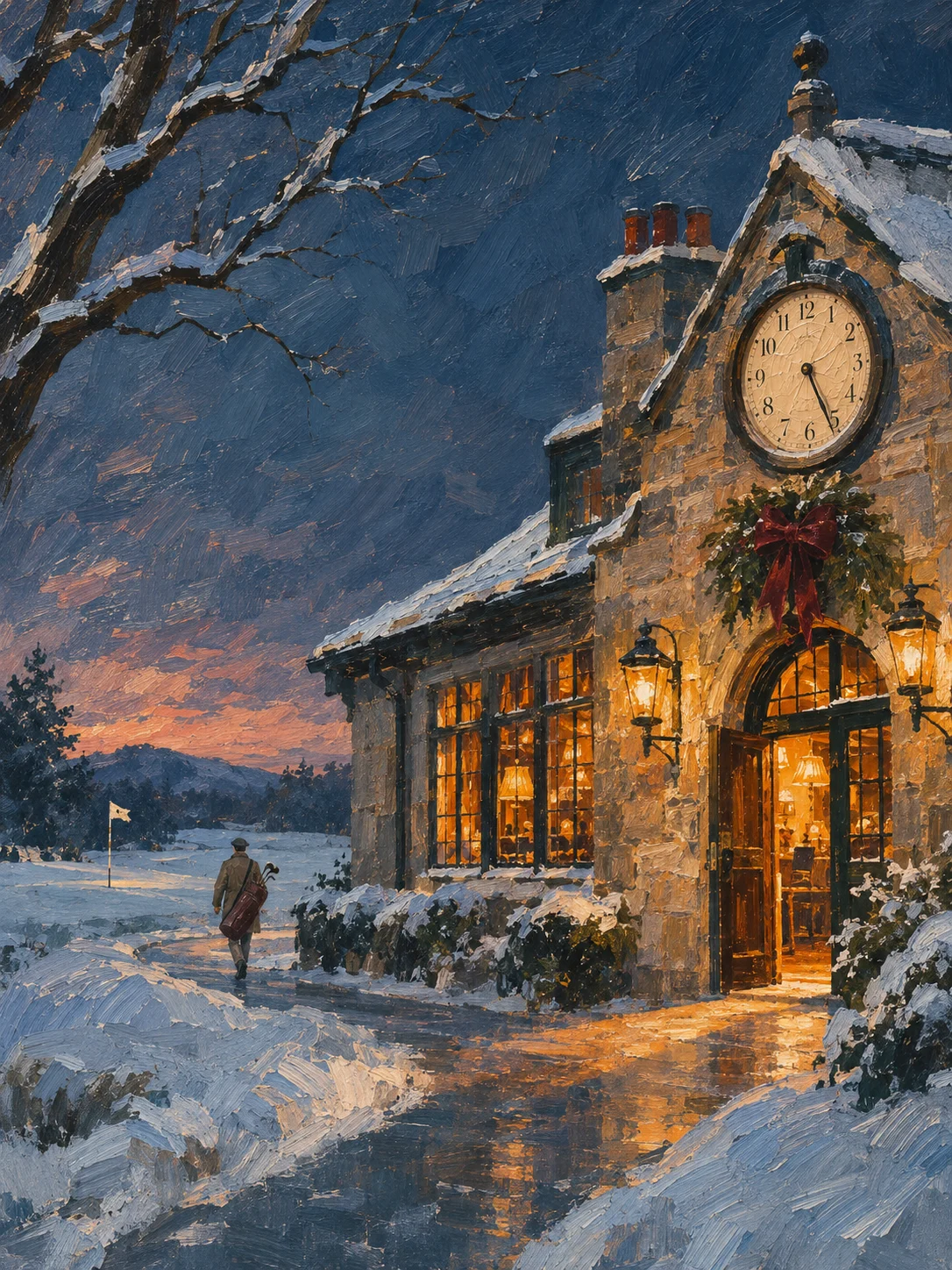
Out on the course, every minute has a purpose. Inside, time becomes a more negotiable arrangement.
The final putt is over, the bags are put away, and someone has said, quite firmly, that they cannot stay. That person is now halfway through a second story about the seventh hole.
On the wall, the clubhouse clock continues its very reasonable work. The people beneath it have made other arrangements.
Golf is unusually attentive to time. Tee times are precise. The group behind is rarely theoretical. Daylight has a way of making its opinion known, particularly as November gives way to the holidays. But cross the threshold after a round and the clock seems to lose a little authority. Nobody has stopped watching it. They have simply stopped obeying it with quite the same enthusiasm.
The round after the round
A golf round ends in stages. There is the final handshake, the walk from the green, the business of finding all the clubs that somehow migrated into the wrong pockets. Then comes the part not printed on the scorecard.
A damp cap is put on an empty chair. Someone orders a drink and immediately starts reconstructing a shot that, with each retelling, becomes slightly more difficult. Another player remembers a putt differently. The disagreement is not serious enough to settle and far too enjoyable to abandon.
The clubhouse makes room for this peculiar second round. No one has to stand over a ball. No one is looking for the group ahead. The bad shots are already becoming funny, which is often their most useful destination.
The stories worth keeping have a habit of outlasting the round. Mark Frost’s The Match turns one remarkable private game into an entire book. An appropriate addition to a room where nobody has actually finished leaving.
A legendary private round, a wager, and the kind of story that improves the longer someone stays to tell it.
There is a freedom in sitting still after several hours devoted to trying to make a small white object go somewhere specific. It might be the most dependable part of the game.
Not every clubhouse needs a leather chair
It is easy to imagine the perfect clubhouse as a room full of oak paneling, old photographs, and a fireplace with impeccable timing. There are fine examples of that sort of room. But the pleasure is not exclusive to buildings that look as though they require a membership committee to approve the curtains.
A municipal course may offer a few tables, a counter, a view of the first tee, and someone who knows exactly which foursome is responsible for the argument at the window. The chairs might not match. The coffee might have been on for longer than anyone is prepared to admit. It can still be the right room.
What matters is that the place belongs to what happened outside. Shoes carry a little grass through the door. The wind is discussed as if it were a difficult colleague. A player who spent four hours saying very little becomes unexpectedly fluent when asked about the one birdie.
The architecture is useful. The company is the attraction.
By the time a wreath has appeared on the clubhouse door and frost has found the first tee, the room becomes a refuge for the rounds already played and the ones being planned for spring.
For a look at the grander side of the room, architect Richard Diedrich’s Legendary Golf Clubhouses of the U.S. and Great Britain explores the architecture and history of remarkable clubhouses. The buildings are interesting. What people do inside them is the better story.
Five more minutes
Every clubhouse has some version of the five-minute departure. One person stands. Another remembers a question. Someone discovers the photograph from the third tee. The person who wanted to leave first has now taken a seat again.
There is no great efficiency to this. That may be precisely why it matters.
Much of the day is arranged around appointments, alerts, and things that arrive with a time stamped on them. Golf, despite its rules and measurements, creates the occasional hour that resists being optimized. A conversation can wander. A silence can stay silent. Nobody needs to prove that the table was used productively.
The scorecard, meanwhile, is folded and placed in a pocket. The numbers will eventually matter less than the people who were there. We have written before about the scorecard worth keeping. The clubhouse is where some of those numbers acquire their stories.
Closing time, more or less
Eventually there is a last look toward the course. The fairway is empty, or nearly so. A chair moves back beneath the table. Someone says that next time the group ought to start earlier, a proposal that will be discussed at length and probably forgotten.
Outside, the time on the clock is exactly what it was always going to be. The afternoon has ended. Nothing much has been accomplished since the final putt.
Except, of course, the part everyone may remember.
Shop this story.
The useful details, gathered together.
A book for the stories that begin on the course and end sometime after everyone says goodbye.
Affiliate disclosure: This retailer link may earn The Links Edit a commission from qualifying purchases. As an Amazon Associate I earn from qualifying purchases.
A note worth opening. For Par is our free note on golf, style and the occasional detour, with free art for your walls and your TV. Explore For Par and subscribe free.