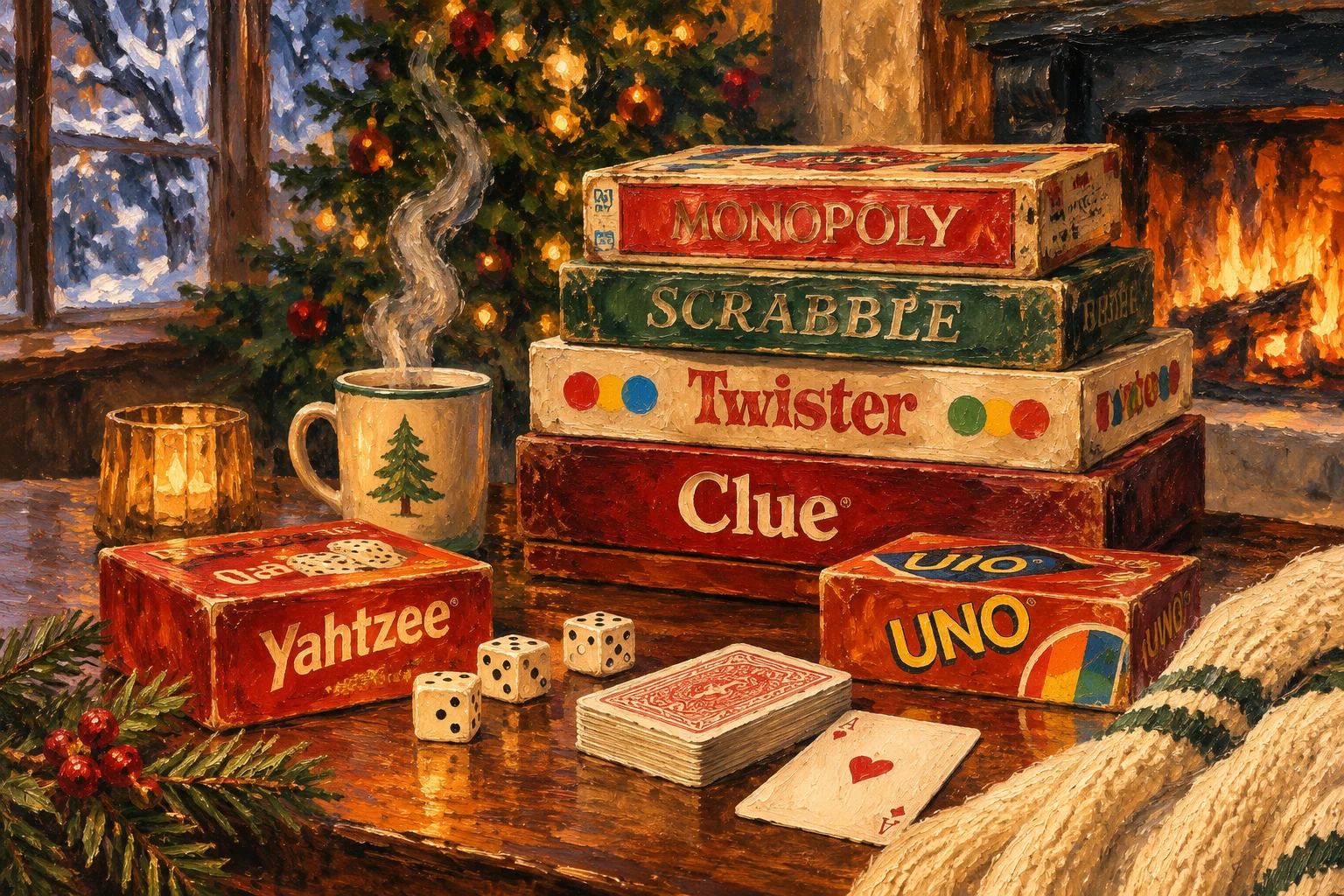
The plates are cleared. Nobody is ready to leave.
Shop this story.
Seven old favorites. The rules may be less settled.
The classic property game. Excellent for anyone prepared to discover a new side of Uncle Paul.
Wooden tiles and scorekeeping that can turn a two-letter word into a family hearing.
A colorful mat for the part of Christmas evening when the furniture moves.
Suspects, rooms and accusations. A calmer way to accuse a relative of something.
A small deck that makes an entire table suddenly remember its own house rules.
Five dice, a score sheet, and the mysterious confidence of someone rolling for a full house.
Two proper decks for the card table. Euchre needs cards, not a themed boxed-game invention.
Affiliate disclosure: Some retailer links may earn The Links Edit a commission from qualifying purchases. As an Amazon Associate I earn from qualifying purchases.
By eight on Christmas evening, the person who said they were “not really competitive” has become rather particular about the rules. Forty minutes earlier, this person was perfectly pleasant.
The good plates are back in their cupboard. Somebody has produced a bowl of leftover chocolates. There is talk of putting on a film, which immediately creates three separate conversations about which film and whether anyone can remember the password.
Then somebody opens the games cupboard. The family has found something new to disagree about.
Someone is buying Boardwalk. Again.
Monopoly has the great advantage of requiring no new acquaintance with anyone’s character. The board comes out, the money changes hands, and an otherwise generous person begins charging rent with quite extraordinary enthusiasm.
One cousin buys everything. Another refuses to trade on principle. A third insists the rules permit an arrangement that nobody can find in the instructions. The game’s real estate may be imaginary; the grievances are reassuringly concrete.
The classic property game. Excellent for anyone prepared to discover a new side of Uncle Paul.
For a quieter kind of competitive behavior, there is Scrabble. Wooden tiles, a little rack, and the opportunity to learn that a family member has been collecting unusual two-letter words for precisely this occasion.
A respectable score can be lost to an obscure word that is, apparently, in the dictionary. Nobody is entirely pleased to discover this. Least of all the person who brought the dictionary.
Wooden tiles and scorekeeping that can turn a two-letter word into a family hearing.
A little less dignity, if you please.
Somebody eventually suggests Twister. This is usually somebody who has had the foresight to remain seated. The mat goes down, the room makes space, and several people discover that the difference between a left hand and a right foot becomes surprisingly complicated under observation.
The best role may be the person operating the spinner. A comfortable chair is an underrated game-night accessory. Spectating is entirely respectable.
A colorful mat for the part of Christmas evening when the furniture moves.
Clue restores a little composure, at least superficially. A crime has occurred in a grand house, and everyone at the table now has a motive to question everyone else. This is easier than asking who left the serving spoon in the wrong drawer.
There is a pleasing seriousness to the tiny envelope, the notes, and the accusation delivered as if the family has suddenly acquired a legal department. The wrong suspect can be named with enormous confidence.
Suspects, rooms and accusations. A calmer way to accuse a relative of something.
A deck, five dice, and several confident opinions.
Not every Christmas game requires the whole dining table. UNO can begin while the last mugs are being collected. It starts with matching colors and numbers and ends with the discovery that every household has invented a slightly different set of rules.
There are reverses, draws, wild cards, and somebody who insists they definitely said “UNO.” Everyone else remembers the moment rather differently.
A small deck that makes an entire table suddenly remember its own house rules.
Yahtzee has a different rhythm. Five dice rattle, a score sheet fills, and hope becomes mathematically ambitious. A full house looks wonderfully sensible until the last roll produces something less helpful.
It is a good game for the relative who announces, before every throw, that the odds are in their favor. The dice do not appear to have been informed.
Five dice, a score sheet, and the mysterious confidence of someone rolling for a full house.
The last deal rarely is.
Then there is Euchre, the card game that asks for four people, two partnerships, and a remarkable degree of faith in somebody else’s judgment. A standard deck supplies the cards. The experience is supplied by the people sitting opposite you.
Someone calls trump. Someone else’s expression suggests this was a mistake. The partners carry on with the delicate politeness of people who intend to revisit the decision after everyone has gone home.
There is no need for an expensive special edition or an elaborate gift set. A good pack of Bicycle cards does the job. The difficult part is agreeing who deals first.
Two proper decks for the card table. Euchre needs cards, not a themed boxed-game invention.
A family games cupboard is a peculiar little archive. One box remembers your childhood. Another still contains a score sheet with someone’s handwriting on it. A third has a missing pencil, which nobody is prepared to discuss.
As a Christmas gift, a game is a modest promise of another evening together. The better present may be the invitation to play it.
By ten, the person who was leaving at nine has moved closer to the table. Someone has found the leftover potatoes.
There is a proposal for one more round.
Strictly for the company, of course.
A note worth opening. For Par is our free note on golf, style and the occasional detour, with free art for your walls and your TV. Explore For Par and subscribe free.