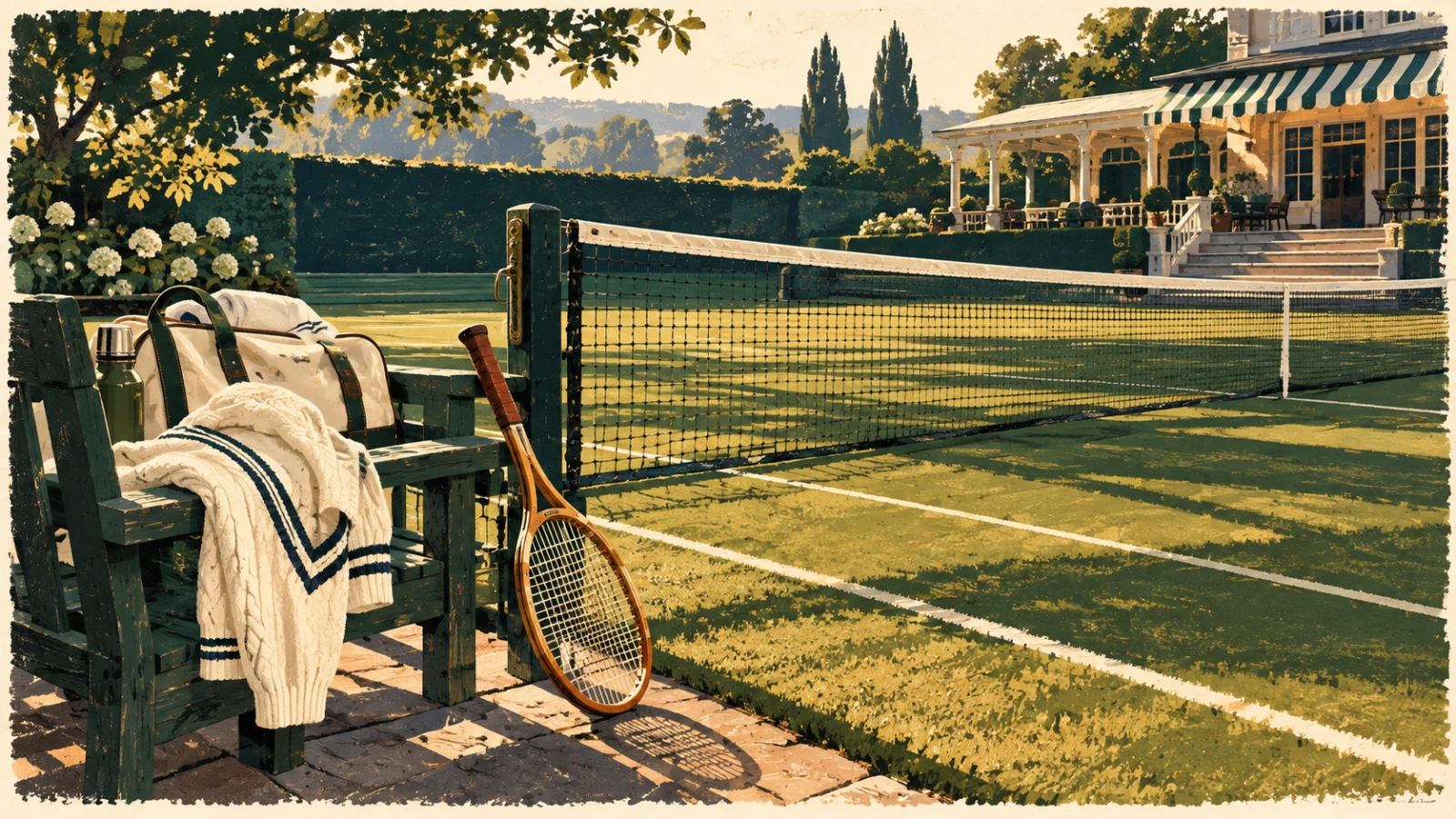
The court is at its best before anybody has had the opportunity to disagree about a line.
At 7:42 on a Saturday morning, a man in immaculate tennis whites is searching his bag for a fresh overgrip.
He removes a banana, three loose tennis balls, a towel, and a receipt from a restaurant he visited in April.
Meanwhile, the overgrip is in his hand.
His doubles partner notices, says nothing, and continues stretching. After all, some friendships are built on knowing when to remain silent.
And this is the part of tennis that rarely makes the highlight reel.
Before the first serve, there is a little world of preparation, routine, and unnecessary fuss. And on a beautiful morning, it might be the nicest part of the entire game.
The Court Before the Contest
After all, an empty tennis court is an unusually confident piece of architecture.
For now, the lines are exact. Someone has pulled the net tight. Meanwhile, a bench waits beside the fence, suggesting that somewhere in the design process somebody remembered we are human.
Then morning shadows cross the service boxes. Still, the court has not yet collected stray balls, abandoned water bottles, or the brief indignity of someone blaming a perfectly good racquet.
For now, everything is orderly.
That won’t last.
Before play begins, there is a quiet choreography. Bags open. Someone tightens a pair of shoes. Someone pulls a sweater over their head and immediately decides it’s too warm.
A player adjusts a grip. Another bounces a ball.
The ball bounces again.
In fact, tennis has enough rituals to occupy an entire morning, though very few have ever appeared on a scoreboard.
The Things That Come Along
Good tennis equipment has an attractive honesty. After all, it looks better when it belongs to somebody.
A racquet leaning against a bench. Shoes with a little court dust on the soles. A bag that has clearly made the same journey a hundred times.
Still, a few pieces deserve particular attention.
A tennis bag should carry the things required for tennis. Of course, this sounds obvious until you encounter one designed as though its owner is relocating to another country.
An organized home for the racquets, shoes and all the things that somehow travel with them.
The Babolat Pure Aero is a serious bag, with room for multiple racquets and space set aside for shoes and smaller essentials. Admittedly, it’s perhaps more bag than the occasional Sunday player needs.
But for someone who regularly plays, practices, and carries extra equipment, the organization makes sense.
The best part, however, is knowing where everything belongs. Whether it actually gets returned to that place is another matter.
Clothes With a Part to Play
Meanwhile, tennis clothing has a wonderful history of looking entirely respectable while its wearer is behaving rather badly.
A proper collar for a morning that may not stay quite so civilized.
The NikeCourt Dri-FIT polo keeps the traditional collar and adds moisture-wicking fabric built for the movement of the game. It’s classic court clothing, clean and athletic, and less interested in decorative flourishes than some of its competitors.
After all, a tennis shirt has enough work to do without becoming the first opponent of the morning.
And there is a reason proper tennis shoes look different from ordinary trainers.
Tennis, after all, involves a remarkable amount of moving sideways, changing direction, and discovering that the ball has landed somewhere inconvenient.
Support for a game that spends an unreasonable amount of time moving sideways.
The ASICS Gel-Resolution X is built around stability and support for those movements. Still, it’s a substantial court shoe rather than a delicate one, which makes it a sensible choice for regular players who like a planted, supportive feel.
And it is considerably more sensible than arriving in fashionable running shoes and asking them to perform an entirely different occupation.
In fact, some of the best tennis equipment costs relatively little.
A small refresh for a racquet handle that has grown far too familiar.
The Yonex Super Grap is a tacky overgrip designed to improve the connection between hand and racquet. And it’s exactly the sort of detail that experienced players notice and casual players tend to ignore.
Besides, a fresh grip makes the handle feel familiar again, particularly when the old one has quietly become something resembling polished leather.
Unlike the player in our opening scene, try remembering where you put it.
The Racquet Has Opinions
Elsewhere on the court, some tennis players develop a relationship with their racquet that would be considered unreasonable in almost any other context.
A considered frame for the player who likes to choose a racquet deliberately.
The Wilson Blade 98 16×19 V10 is a serious frame built around control and responsive feel. In particular, its 98-square-inch head and 16×19 string pattern will interest players who enjoy making deliberate choices about their equipment.
That said, it’s not the racquet we’d recommend buying blindly for someone else. After all, weight, balance, grip size, and the way a frame feels through the swing matter more than how attractive it looks beside a tennis bag.
Ultimately, the best racquet isn’t necessarily the newest one. It’s the one you stop thinking about when the point begins.
The Fresh-Can Optimism
Still, there is a particular satisfaction in opening a fresh can of tennis balls.
The small hiss. The clean felt. Finally, three perfectly respectable yellow spheres that have not yet been introduced to the fence.
A fresh can and three perfectly reasonable expectations, for approximately four minutes.
Wilson’s US Open balls are familiar, dependable, and entirely unpretentious.
Even so, a new can is one of the few purchases in sport that can make everyone feel momentarily optimistic. For approximately four minutes, every player believes the day might go exceptionally well.
A Court Worth Arriving Early For
Of course, tennis is also about the place.
Grass with its quiet geometry. Clay carrying the marks of earlier matches. Hard courts divided into wonderfully decisive blocks of color.
Still, the surface changes the view, but the essential arrangement remains familiar.
A rectangle. Two opponents, or four. A very small ball.
And an opportunity to take an ordinary afternoon far too seriously.
There’s something almost architectural about the game. The measured lines, the repeated movement, the sharp sound of contact, the sudden interruption of silence.
In short, the court feels complete before a single person enters it.
Then the players arrive and begin making it complicated.
The Few Minutes Worth Keeping
Of course, we tend to remember the match.
The improbable return. An argument about a baseline. The final point that everyone describes differently afterward.
And we remember the missed opportunities, occasionally in extraordinary detail.
But the minutes beforehand have a charm of their own.
Nobody has won anything yet. Nobody needs to explain the score, either. For now, the morning is still unclaimed.
Meanwhile, someone finishes tying a shoe. Another player takes a final sip of coffee. A racquet is lifted from the bench.
For a little while, there is no pressure to do anything remarkable.
Just the prospect of a good morning outside, interesting company, and a game that hasn’t yet had the opportunity to disappoint anyone.
Eventually, somebody steps to the line.
Naturally, the first serve hits the net.
The peace had a good run.
Keep reading: gifts under $50 that still feel like gifts, the full kit, considered, why golf shoes look like golf shoes again, or Off the Wall.
Affiliate disclosure: Some retailer links may earn The Links Edit a commission from qualifying purchases. As an Amazon Associate I earn from qualifying purchases.
A note worth opening. For Par is our free note on golf, style and the occasional detour, with free art for your walls and your TV. Explore For Par and subscribe free.